Saturday, September 26, 2015

September Conservation Tip

Build a Pollinator Garden


Last summer I stumbled upon a post from the Xeres Society about taking the pledge to protect pollinators. Intrigued by that idea I took the pledge:

 To Bring Back the Pollinators, I will: 

1. Grow a variety of bee-friendly flowers that bloom from spring through fall.
2. Protect and provide bee nests and caterpillar host plants.
3. Avoid using pesticides, especially insecticides.
4. Talk to my neighbors about the importance of pollinators and their habitat.

Pollinators such as bees, butterflies, birds, beetles, bats, wasps and even flies are important and are declining fast due to the use of pesticides and an ever-expanding conversion of landscapes to mono-cultures or lawns. So I wanted to do my part and help them to come back. Kind of selfish in a way, since our vegetable garden and fruit trees would profit from it!

Thinking about where and how to set up a small pollinator garden, I found a perfect spot in between some big rocks. Last fall then I prepared the eroded soil in permaculture fashion to build up soil for this year. For more info on how to build your "own" soil with the permaculture method, check out my Conservation Tip from January 2014.
I then covered it up with silage foil and let it sit until spring. During winter I tried to figure out what would make sense to plant in our climate and made sure to have all the seeds ready. Some flowers, like the milkweed and the snapdragons I started inside at the end of February.


In May I uncovered it the little garden and installed soaker hoses.
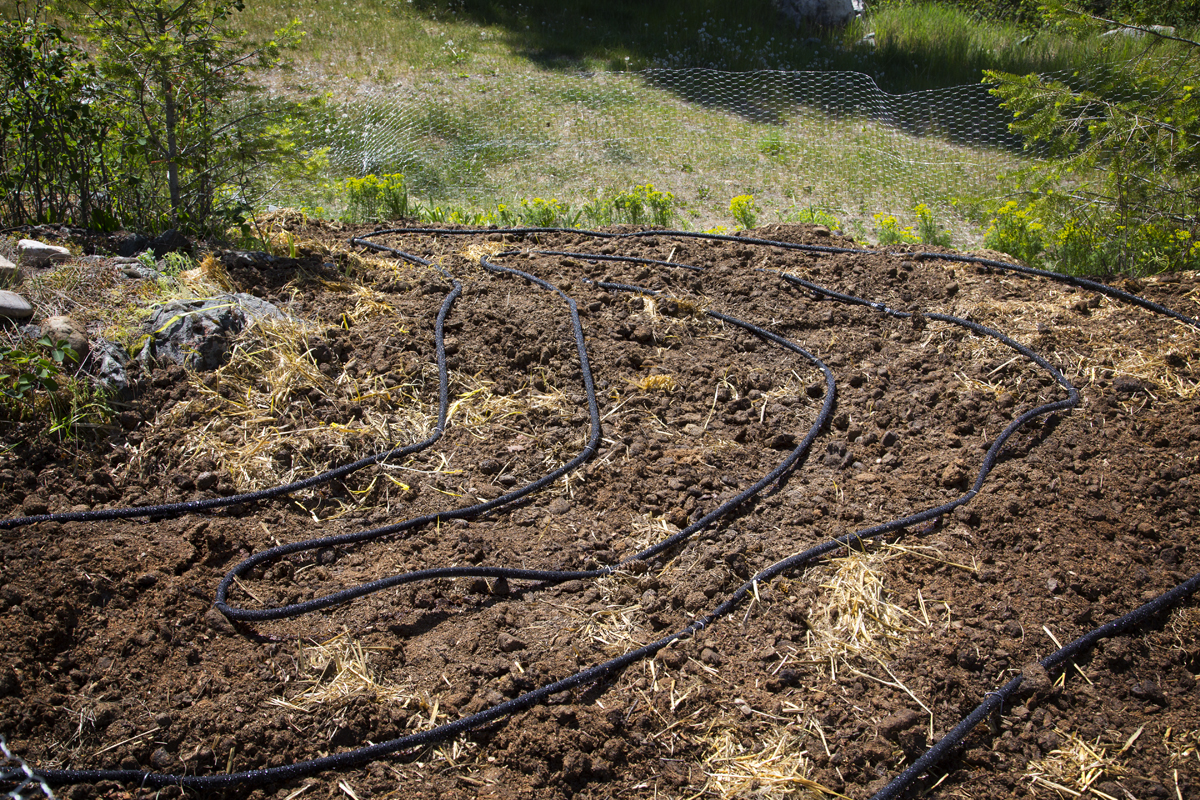

I made a "plan" where to plant what and got to work...
The chickens really wanted to help, but since they thought they best help by eating the seeds, I had to surround it all by chicken wire.


First I covered the soaker hoses with soil and planted the plants I had bought (lavendar) or started inside (milkweed and snapdragons), then I put the seeds in the ground and hoped for the best. I also put up two deep dishes filled with water and rocks (to provide landing spaces), for the bees to drink.


It took quite some time, at least four weeks until everything started to actually grow, but then it kind of exploded and in August it looked like this:


It doesn't look like much since the sunflowers kind of took over and blocked the view of everything else, but the following close ups show the abundance

Snapdragons


Blue Poppy


 Amaranth


 Milkweed, a very important plant for the Monarch Butterfly

The place was and still is humming and bustling with all kinds of insects. The hummingbirds are gone by now, but enjoyed the garden during the summer. Not all the plants I planted did well, the Lupines never came, neither did the Forget-me-nots. Others like the sunflowers and the nasturtium took over way more space than I had planned. I guess there is a learning curve....
 

Right now I'm preparing another patch, this time right within our vegetable garden to have a second pollinator garden.

Get the shovel ready to start yours!

Here some websites that will help you find the right plants for your region and provide a lot of other tips and tricks:

Xeres Society

Pollinator Partners

Create a bee-friendly garden

kids gardening

Grow a greener world

Color in the Kootenay National Park

Paint Pots and Marbel Canyon

At the beginning of September I was the photographer and local guide for a travel writer friend of mine from Europe. It is always fascinating to see the reaction of visitors to our close by wonders. One becomes aware again of the vast beauty around us.
Banff National Park was on top of our to see list. The plan was to wait for nice weather and then head up there. Unfortunately the conditions went from super smoky to overcast to rainy, and time was running out. We decided to ignore the weather and go anyway.
On the way to Banff lays Kootenay National Park. Although it does not have the majestic views of Banff and surroundings, it does have some gems that are well worth exploring. 

First off there are the Paint Pots...

The 2013 flood washed out the suspension bridge over the Vermillion river, so the Paint Pots were not accessible until this summer. Now with a brand new bridge it is an easy and very colorful stroll.


 After crossing the bridge wide ochre fields open up. As we were there the water had mostly drained and beautiful colored rocks covered the ground.


Various sediments deposited on the bottom of an ancient glacial lake became the clay at the Ochre Beds. The amazing colors result from the saturation of the clay with iron rich water. (2)


The locat Ktunaxa call the ochre beds " the place where the red earth spirit is taken" They "harvested" the ochre, then cleaned it and kneaded it with water into walnut sized balls. These ball got flattened into little cakes and baked. The baked cakes then were ground into a powder which they mixed with fish oil or animal grease to paint their bodies, tipis, clothing or pictures on the rocks.


The trail leads then from the Ochre Beds along a very brightly orange colored stream to its source, the actual springs which form the Paint Pots.


Walking up the trail one really can experience the clay nature of the ground...in other words: It's rather slippery! Supernatural colors though...


The trail ends at the Paint Pots. The smallest looks more like a big puddle but the two bigger ones are stunning.


The Paint Pots themselves are formed by the accumulation of iron oxide around the outlets of three cold mineral springs. As the rim of iron builds up around each pot, they gradually increase in height. The greenish colour of the two larger pots is the result of the mixing of fresh water from a small creek, which empties into the largest pool.(1)


 What an unusual place!


In the early 1900s a mining company tried to exploit the Ochre Beds as a source for paint pigment. That undertaking failed relatively soon and the mine site was abandoned. Some of the equipment still sits there, slowly rusting away.


Continuing Hwy 93 towards Banff shows why wide parts of the Kootenay National Park are also called "Lightning Alley". In 2003 multiple big fires, caused by lightning, burned huge areas of the park and the remaining burned trunks are an impressive sight. They would be also an depressive sight, but the fresh green trees and plants, especially the bright purple fireweed, among them are showing the regenerative power of fire.


Historically forest fires are part of a natural cycle. After a wildfire, over a long period of time, the various stages of the post-fire habitat can support a much broader variety of species than the mature pre-fire forest did. Before these big 2003 fires, fires in the park got managed by trying to extinct them as soon as possible. But later on, as the positive effect of the wildfires became evident, the fire management strategy includes now a prescribed burn program. It is expected that by 2018 to 2023 the burned area will be prime grizzly bear and moose habitat.(3)


For now it seems it is prime fireweed habitat...


Fireweed is also abundant at the next stop, Marble Canyon.


It took Tokumm Creek, a glacially fed creek, approx. 8000 years to slowly but steady erode the surrounding dolomite bedrock into todays' canyon. Is it real marble? No, true marble would be metamorphic dolomite altered by heat and pressure. Although Marble Canyon is formed into dolomite rock it is not metamorphic. The silt laden glacial waters of the creek though smoothed the sides of the canyon to a marble like shine.


Multiple bridges span over the canyon and ...


...the views down to the rushing turquoise water are amazing but maybe not for the faint-hearted, as the canyon reaches a depth of almost 40 meters.


The 2003 fires also left their mark here at the canyons' surroundings.


A great example how live finds a way back and actually thrives after a fire. Who can spot the little spider?


After about 600m the beginning of the canyon is reached, a beautiful small waterfall.


There is one more place I want to check out along the Kootenay Park, the hike up to Stanley Glacier. Since the hike is know for it's spectacular wildflower display in July, it is on my agenda for next year!

For more information on hikes and guided tours in park please check out 10Adventures

(1) The History of the Paint Pots

(2) Canadian Rockies Explorer by  Graeme Pole

(3) Kootenay National Park

Sunday, August 23, 2015

August Conservation Tip

Why some zucchini are to die for...

...quite literally as a couple of weeks ago a senior citizen in Germany died of  zucchini poisoning.
More about this at the end of this post, let's celebrate the zucchini first, as its health benefits outweigh its possible dangers by far.


First of all zucchini are really easy to grow and come in many different varieties. Zucchini is one of the very low calorie vegetables with only 17 calories per 100 g. It contains no saturated fats or cholesterol and the peel is good source of dietary fiber. Zucchini are also a very good source of potassium, an important intra-cellular electrolyte. And they are rich in Vitamin A and C. (1)

Right now, in gardens near and far, they are prospering and the number one topic between gardeners is:"What to do with all the zucchinis..."


Well, there are filled zucchini, zucchini bread, zucchini fries, salsa with zucchini, pasta with zucchini, zucchini salad, quesadilla with zucchini and the list goes on and on.

Our very favorite recipes are zucchini feta fritters, so I thought I share that recipe with you

For about 4 servings you will need:

4 cups grated zucchini, that's about a good pound
2/3 cup of flour
1 tsp baking powder
1 cup crumbled feta cheese
4 large eggs, separated
1 bunch thinly sliced green onions
some freshly chopped parsley
some freshly chopped mint
olive oil, salt and pepper and some sour cream for serving

Let the grated zucchini stand in a sieve for about 20 min and squeeze out any excess fluid at the end of that time. Combine with egg yolk, crumbled feta cheese, green onions and the herbs. In a separate bowl combine the flour with baking powder and add salt and pepper. Stir zucchini in the flour mix. Beat egg white until soft peaks form and fold carefully into zucchini batter.

Heat the olive oil in a frying pan over medium heat and add zucchini mix with spoonfuls of the batter. Fry until crisp, about 2 min per side. Transfer to a paper towel and keep warm while you are frying the rest of the batter. Serve with dollops of sour cream....hmmm so yummy
Adapted from "Cooking from the Farmers' Market"


For more recipes check out this link: More Zucchini Recipes

But one can only eat so much zucchini, right? Eventually we will have enough....but then in the deep of winter, what would we give....Did you know, that you can freeze zucchini really well?
Whatever we can't or don't want to eat, I grate and either freeze pre-portioned for a favorite recipe ( for example 1 lb for the fritters, although you have to freeze a bit more than the recipe calls for, as zucchini will loose water when thawed) or I fill it in big ice cube trays and freeze it this way. After a day or two I take it out of the trays and store it in a ziploc bag. I use the cubes for soups and casseroles, adding a bit of summers' flavor during the winter.


Now, as promised, more about the zucchinis' dark side....
As I first heard about the death of a German retiree I wouldn't believe it...poisoned by a zucchini?? It's true and I will post the link for any one who wants to read up on it, it is in German though. Researching the topic I found out the following:
Zucchini, as well as cucumbers may occasionally contain a group of natural toxins known as cucurbitacins. These toxins give zucchini a bitter taste. Bitterness in wild zucchinis has been known for a long time, Scientist assume the plant produces the cucurbitacins to protect its self from herbivores.
Eating bitter zucchinis has caused people to experience vomiting, stomach cramps, diarrhoea and collapse. And now, for the first time in record, someone died of it. I think this is a really rare occasion and the reports states, that the man who died ate the zucchini a neighbor and gardener gave him, although it tasted extremely bitter.
All "commercial" zucchini and seeds that are on the market are practically free of cucurbitacins. But if grown together with pumpkins and other plants from the squash family cross pollination can happen and therewith a transformation back to the "wild form". Since more and more people are saving their own seeds the possibility of cucurbitacins coming back is given.

Long story short: Enjoy the zucchini but DO NOT EAT A BITTER ZUCCHINI!!!


The zucchinis blossoms in my garden at least making the peace sign...I guess I'm fine...;-)


Sources:
(1) Zucchini Nutrition Facts 
(2) Spiegel article about the incident, in German
(3) Food Safety New Zealand

Thursday, August 20, 2015

Meet Shadow


...another puppy girl. This time a Belgian Shepherd, to be more precise, a Malinois.


Isn't she ever so cute??


There are four types of Belgian Shepherds, the Tervuren, the Groenendael, the Malinois and the Laekenois. In Belgium where the breed originally comes from all four are seen as varieties of one breed, the Belgian Shepherd. In North America though, all four are handled as separate breeds. (1)


" The Malinois is very active and will thrive on lots of regular and varied physical exercise and mental stimulation. Problems arise, though, when this smart, people-oriented dog is underemployed and neglected. Exercise, and plenty of it, preferably side by side with their adored owner. Intelligent and trainable, the Belgian Malinois possesses a strong desire to work and is happiest with regular activity and a job to do." (3) Yup, I think her owner has some work cut out...this little girl was quite energetic, but I have to say, already listened very well!


The US military uses the Malinois for many different tasks. I have even seen images of the White House with Malinois on guard. The SEALs for example train these dogs to parachute, jumping either in tandem with their handlers or solo. "In 2010, a canine parachute instructor and his dog Cara set the world record for highest man-dog parachute deployment, jumping from more than 30,100 feet up — the cruising altitude of transoceanic passenger jets. Both the instructor and Cara were wearing oxygen masks and skin protectors for the jump." (2) Crazy....


I tried my to set up for some more "formal" images, but no chance. Shadow had her own idea what to do with the backdrop...


A fun photo shoot this morning. I hope I will have the opportunity to play more (camera) catch with Shadow in the future.


(1) The Belgian Sheperd

(2) Malinois

(3) AKC Malinois

Thursday, July 30, 2015

Mate

Some of you have met our new feline family member already on facebook.
But since he is so cute, I thought a blog is in order.
To get most out of the images please feel free to click on them for an enlarged view.

Meet Mate who took our hearts by storm


The first time I tried to photograph him, he would jump every time I pressed the shutter....a camera shy kitten? But repeated "exposure" made a pro model out of him.


Always curious, always exploring...

 In order to emphasize his blue eyes, I experimented in the post processing. Rather then to intensify the blue of his eyes, I actually desaturated everything but the eyes (or the mouse).


The "studio" shots...


This ball of wool tried to escape,


 ...but no chance, he got it ;-)


 Cat in a basket

 Mate in the jungle

Here Mate gets inspected by Zippo. You can still see where Zippo 
got shaved for his emergency surgery


Well, modelling is an exhausting job...


...time for a nap