Tuesday, November 11, 2014

November Conservation Tip

Put some aroma in your life!

When it comes to food, nothing beats homemade. In my opinion. It's made with love and you can choose the ingredients. I would much rather receive or give away something homemade than something fancy made with ingredients I can't even pronounce. 
After the recipients of my homemade gifts are now well stocked with jams, jellies and salsa, I wanted to come up with something new. Infused oils seemed to be an easy to make and an easy to please idea. I tried my three favorite flavors, lemon, basil and rosemary. Well, the lemon one turned out ok, the basil one molded before I even could try it (luckily, as I found out later) and the rosemary one looked nice with a whole branch of rosemary sticking in a decorative bottle, but didn't taste that much of rosemary.....hmmm, nothing to be proud of and certainly nothing to give away as present.
But there is a solution to every problem and mine came in the form of a brochure of the nearby College of the Rockies offering a class on Infusing Oils and Vinegars. As I read that the instructor would be Danielle Cardozo, a Masterchef Canada competitor whose every episode I watched on TV, I signed up right away.

I'm glad I did!
After a quick introduction, Danielle showed us the most common vinegars and oils


and explained in detail which ones worked best for infusions and which ones are better for other uses.
We tasted every one of the oils and vinegars present to get an idea of the different flavors.


White Balsamic vinegar was new discovery to me and I have to say, I really like it.


Then we went over some of the ingredients and do's and don'ts when it comes to infusing oil and vinegar. Here I learned why my basil oil went bad and how lucky I was not to have tried it. All fresh herbs and other ingredients that contain water, as for example basil and garlic, can harbor bacteria. Enclosed in oil, anaerobic bacteria as the Colstridium botulinum, can thrive. This particular bacterium is rather common and produces a neurotoxin that can be deadly. Danielle advised us strongly to use up oil with fresh ingredients within a few days and store it in the refrigerator. Or use dried herbs and dried garlic for infusions with a longer shelf life. Only exception to the rule is citrus zest, since it's "liquid" is oil not water based. Also dried herbs generally produce a more flavorful infusion if they get grounded up in a mortar before use.


For inspiration, Danielle had prepared some oil and vinegar infusions ahead of the workshop, and had us taste these before we went to work with our own creations. I could have spent the rest of the time just dipping away, that's how yummy they were.
Nevertheless, we put on our aprons and let our imagination run. Since I like citrus and mango a lot, I started with a mango vinegar and a citrus oil. I tried a few more and will share my two favorite concoctions below.


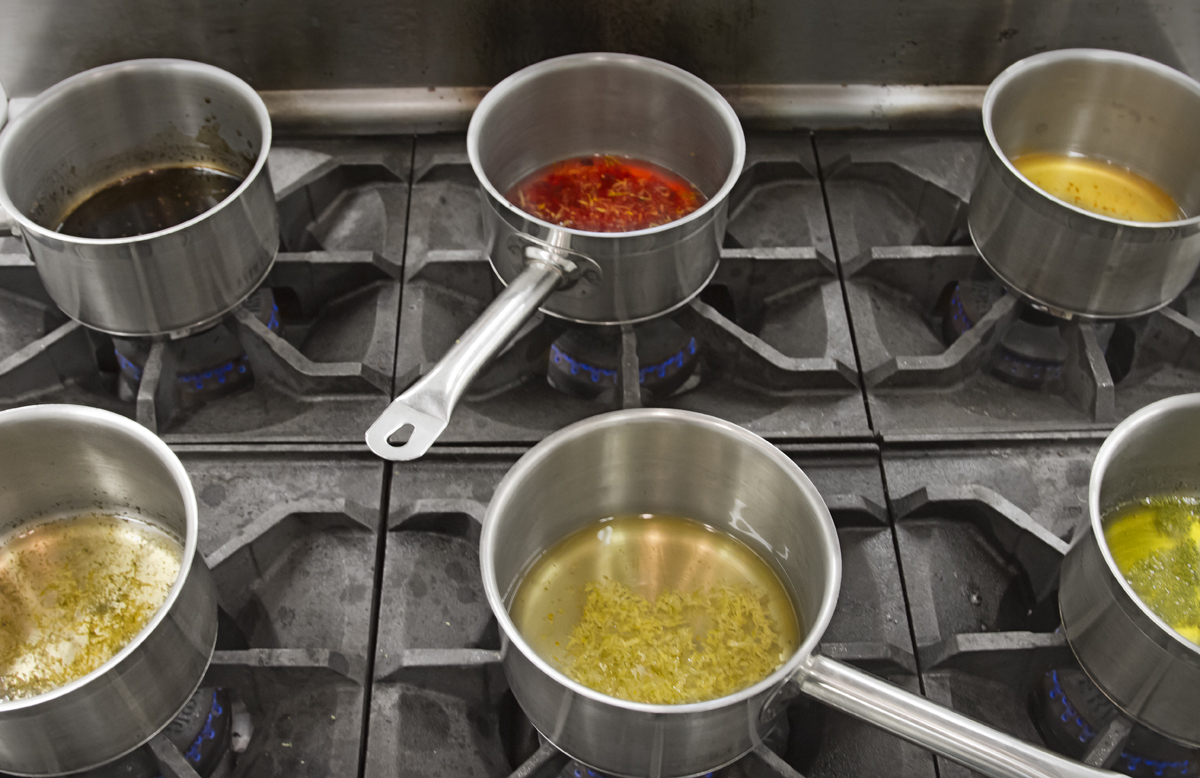
Most recipes for infused oils and vinegars I came across so far, had me mix the ingredients and then wait for a couple of weeks....Danielle though has a different approach, which I, impatient as I am, like much better. Mix your ingredients and then heat your oil or vinegar up to 65-85˚ C / 150-185˚ F. Best in a water bath and for up to 8 hours.


She brought her great SousVide to class which keeps the set temperature for as long as you want, and we all dropped our infusions in there, amazing what this machine can hold. A few of the recipes though were calling for reductions and there came some tempting smells from the stove.


While all our creations were infusing, Danielle sat down with us for some Q&A and of course we all wanted to hear about her Masterchef experience. Danielle confessed to have been a fan of the US and Australian Masterchef series and watching them with her kids. As the Canadian version got announced, her daughter urged her to apply. A few weeks later she had an interview over the phone and got invited right away to an audition in Calgary for which she had to cancel a vacation to Mexico. Shortly after that she competed very successfully in the first Masterchef Canada. I can only imagine what a logistical nightmare it must have been to leave kids and job for up to 44 days and travel to the other end of Canada, no phone, no contact allowed.
Danielle describes the time as a contestant life changing, intense and one she doesn't want to have missed but she is happy to now have her "normal" life back.


We all were spellbound and "smellbound" and only reluctantly pulled our infusions out of the SousVide.


That evening, as you can guess, we had bread and dipping oil and vinegar as appetizer.

As promised, here my two favorite infusions:

Cranberry, cinnamon and vanilla vinegar:
Cut dried cranberries in small pieces, give into a pint mason jar and cover with white balsamic vinegar until just covered for about 1 hour. Add a pinch of cinnamon and about 1/4 to 1/2 teaspoon of vanilla extract. Fill up the mason jar with white balsamic vinegar and close lid. Infuse for 8 hours. Strain and fill into a sterilized bottle. Store cool and dark.
This would make a great host gift for a Thanksgiving invitation....

Since I don't have a SouseVide and are not so much a fan of plastic anyway, I use mason jars. But any container that can be closed and heated up to 65-85˚ C / 150-185˚ F should do. For the "infusion process" I put the mason jars in my canner and filled the canner with enough water to almost cover the jars. I played with my stove settings until I found the right setting to keep the water at a temperature around about 75˚ C/165˚ F, and just left it in there for 8 hours.

Lemon and anise vinegar:
Combine the zest of an well washed organic orange and lemon with enough white balsamic to fill a pint mason jar, add anise to taste, a little goes a long way. Proceed as described above.

It's only coincidence that I chose two vinegars, the procedure would be the same with oil. In the tasting my favorite vinegar for infusions by far was the white balsamic vinegar, with the oils it was sawflower and light olive oil. But I recommend to give different oils and vinegars a try and see for yourself.

I asked Danielle if she had a favorite cook book on infusions, she smiled and answered:"...the internet".
Here you go, just let your taste buds be the limit and give it a try. Infused oils and vinegars make great host gifts or Christmas presents, or score with homemade infusions at your next dinner party.

P.S. If you live in the Kootenays, keep checking out the College of the Rockies schedule. Hopefully they will offer the workshop again!

Wednesday, October 29, 2014

The Bears of Knight Inlet


One of the highlights of our recent "Explore BC" tour was visiting the grizzly's of the Knight Inlet.
On the north tip of Vancouver Island lies Telegraph Cove, a tiny settlement with a population of about 20. In former days Telegraph Cove was home to a lumber mill and a salmon saltery, nowadays it is a tourist hub for all kinds of outdoor activities, particularly whale watching and grizzly bear tours.


Since space is limited and this is a highly sought after tour during the summer, we had signed up for our tour with Tide Rip Tours long before we started our journey.


Very early in the morning, considering that it was Sunday...;-) we were at the marina and got some last minute instructions. Then off we went in our speed boat heading towards Knights Inlet. The boat ride takes about 2 1/2 hours, but with breakfast served, interesting stories told by our knowledgeable guide, and extraordinary beautiful landscape around us, the time just flew by.


After arriving at the Knight Inlet area we switched from our speed boat to a skiff. With this specially built skiff we slowly chugged through the shallow inlets. Close to the spot were bears can be seen we turned off the motor, the guides gently lowered themselves into the water, which was rather shallow, and quietly pushed the boat further into the inlet.


Patiently we waited, anticipating bears jumping out of hiding at any minute....and waited...and waited...we saw a cute deer family and water planes bringing in guests to a remote lodge, but no bears. Ever so slowly, a hint of disappointment was tangible among us.


The tide was leaving and our time was short and when we had almost lost hope, they came!
Mama bear with two cubs, almost as tall as her.


Due to the tide we had to leave the inlet a bit and the bears were quite a ways way, munching on a tree,


but then the curious cubs came closer and closer.


And finally ran into the water to play!


Mama was always watching to make sure the cubs were safe.


Eventually they had enough of playing in the water,


A quick shake at the beach and off they went, disappearing into the forest as quickly as they had appeared.


What an experience!
After the boat ride back, where we passed the time by dozing in the sun on the back deck of our boat, we enjoyed an Orca Pale Ale at the Killer Whale Cafe..well deserved I think!


Monday, October 27, 2014

October Conservation Tip

October is Vegetarian Awareness Month

Wow, I wasn't even aware that we have an awareness month....;-)
So I thought I should seize the opportunity to answer the question all vegetarians get asked quite frequently: Why are you Vegetarian? Early on this question was quickly answered, I feel sorry for the animals. During my education to become a veterinarian in Germany I had to work at a slaughterhouse, it was part of the education since a graduated veterinarian is automatically a meat inspector. Being passionate about animals before, the time working at the slaughterhouse did the rest. Nowadays the answer is much longer. "Ethical" reasons are still one of the strongest.
And it's not only the slaughtering that bothers me, it's the whole way of how animals are kept and treated throughout their odyssey. Studies have proven that pigs are smarter than dogs, science finally has attested that animals are able of cognitive thinking and have emotions....would you keep your dog his or her whole life in a crate that hardly allows your dog to turn? Never see daylight, never run or play? Would you?? Let's not even talk about how chicken, turkeys or cows are kept and treated.


Ethical reasons are just my personal thing, but environmental reasons should concern everybody.
If you google "factory farming environment" you get about 1,290,000 results in 0.47 seconds....I didn't read all of them but a fair bit and it's scary! There are a lot of different interpretations but most state the same facts, I tried to put together the ten most important:
  1. About 10 billion animals, not including fish farms, in the United States are raised for dairy, meat and eggs each year.
  2. More than 250 million acres of US forests have been clear-cut to create land for producing feed for livestock.
  3. Globally, deforestation for animal grazing and feed crops is estimated to emit 2.4 billion tons of CO2 every year. The cut forests are badly missed in the negation of CO2
  4. 70% of the grain that is produced in the US is fed to farm animals
  5. The Smithsonian Institution has stated that the equivalent of SEVEN football fields of land is bulldozed every single minute to create more land for farming animals.
  6. The use of fossil fuels on farms to grow feed and to intensively raise land animals for food emits 90 million tons of CO2 worldwide every year.
  7. Almost half of all water used in the US goes into the meat, dairy and egg production. Between 1,800 and 2,400 gallons of water is needed to produce 1 lb of meat, only 25 to 39 gallons are needed to produce 1 lb of wheat. In other words one would save more water by not showering for 6 months than one would save by not eating a pound of meat!
  8. The waste lagoons of factory farms aka Concentrated Animal Feeding Operations or in short CAFOs not only pollute our groundwater, but deplete it as well. Many of the farms use the groundwater for cleaning, cooling, and drinking.
  9. The EPA (Environmental Protection Agency) reports that roughly 80 % of ammonia emissions in the US come from animal waste. Atmospheric ammonia can disrupt aquatic ecosystems, ruin soil quality, damage crops, and jeopardize human health.
  10. Factory farming accounts for 37 percent of methane (CH4) emissions. Methane has more than 20 times the global warming potential of CO2. (2,3,4)
To get a real visual understanding of the environmental impact, please have a look at these photos:


Unfortunately, that's not it. To ethics and environment now also comes the topic of health.
With health I'm not addressing issues as too much saturated fats, cholesterol or else, as this is in everybody's own hand. No, I'm more thinking of what a "carnivores" eat with their meat that they are not aware of:
  • Dairy cows can be given growth hormones, recombinant bovine growth hormone (rBGH), in order to increase their milk production. But often this increased milk production leads to mastitis (infection of the udder) which then is treated with antibiotics...Eventually the cows productivity declines, and they are slaughtered for beef. Beef cattle may also be treated with hormones, estradiol, testosterone, and progesterone, to increase and expedite growth. The use of these hormons in dairy cows and cattle  has been shown to significantly increase the risk of breast, prostate, and colon cancer in beef consumers. Producers are not required to list the use of hormones on product labels. 
  • Some zoonotic diseases (diseases that can spread from animals to humans and vice versa)  like BSE/ Creutzfeld Jacob Disease could only cause that much havoc, because someone down the factory farm aisle got the idea to feed dairy cows and cattle animal meal. Not only are bovines strict herbivores, the animal meal was from sheep that had to be put down because of Scrapie ( the sheep form of BSE). At that point nobody knew that the pathogen can jump between species, but just the idea of feeding cows animal meal is simply revolting
  • Now to the antibiotics, since the 1950s, antibiotics have been used at factory farms to increase the rate of growth in animals. Today, an estimated 70 % of the antibiotics used in the U.S. are given to farm animals for non-therapeutic purposes. Since the antibiotic are long out of the body once the animal gets slaughtered all is fine, right? Unfortunately not: It is not the antibiotics directly that are posing the problem but using antibiotics in this way can lead to drug-resistant bacteria; as a result, certain bacterial infections have already become or are on their way to becoming untreatable in humans. Antibiotic resistant infections kill 90,000 Americans every year.
Do I propose everybody should stop eating meat? No, but maybe consume it a bit more consciously.
If possible, choose meat from a farmer you know and who raises the animals properly and without antibiotics. Try buying organic. How about following the "Meatless Monday" rule.
The Environmental Working Group (EWG) published a very informative statistic:
 Over a one year period,
-if you eat one less burger a week, it’s like taking your car off the road for 320 miles or line-drying your clothes half the time.
-if your four-person family skips meat and cheese one day a week, it’s like taking your car off the road for five weeks – or reducing everyone’s daily showers by 3 minutes.
-if your four-person family skips steak once a week, it’s like taking your car off the road for nearly three months.
-if everyone in the U.S. ate no meat or cheese just one day a week, it would be like not driving 91 billion miles – or taking 7.6 million cars off the road.(7)

Small adjustments can help a lot! And thank you for reading the blog, it means a lot to me...
Over a year:
If you eat one less burger a week, it’s like taking your car off the road for 320 miles or line-drying your clothes half the time. 10
If your four-person family skips meat and cheese one day a week, it’s like taking your car off the road for five weeks – or reducing everyone’s daily showers by 3 minutes. 11
If your four-person family skips steak once a week, it’s like taking your car off the road for nearly three months. 12
If everyone in the U.S. ate no meat or cheese just one day a week, it would be like not driving 91 billion miles – or taking 7.6 million cars off the road. 13
- See more at: http://www.ewg.org/meateatersguide/a-meat-eaters-guide-to-climate-change-health-what-you-eat-matters/reducing-your-footprint/#sthash.OUf3QAoE.dpuf


Sources and further reading:
Over a year:
If you eat one less burger a week, it’s like taking your car off the road for 320 miles or line-drying your clothes half the time. 10
If your four-person family skips meat and cheese one day a week, it’s like taking your car off the road for five weeks – or reducing everyone’s daily showers by 3 minutes. 11
If your four-person family skips steak once a week, it’s like taking your car off the road for nearly three months. 12
If everyone in the U.S. ate no meat or cheese just one day a week, it would be like not driving 91 billion miles – or taking 7.6 million cars off the road. 13
- See more at: http://www.ewg.org/meateatersguide/a-meat-eaters-guide-to-climate-change-health-what-you-eat-matters/reducing-your-footprint/#sthash.OUf3QAoE.dpuf
Over a year:
If you eat one less burger a week, it’s like taking your car off the road for 320 miles or line-drying your clothes half the time. 10
If your four-person family skips meat and cheese one day a week, it’s like taking your car off the road for five weeks – or reducing everyone’s daily showers by 3 minutes. 11
If your four-person family skips steak once a week, it’s like taking your car off the road for nearly three months. 12
If everyone in the U.S. ate no meat or cheese just one day a week, it would be like not driving 91 billion miles – or taking 7.6 million cars off the road. 13
- See more at: http://www.ewg.org/meateatersguide/a-meat-eaters-guide-to-climate-change-health-what-you-eat-matters/reducing-your-footprint/#sthash.OUf3QAoE.dpuf
    (1) Compassion over Killing
    (2) Facts about factory farming
    (3) Collective Evolution
    (4) Eating Animals by Jonathan Safran Foer
    (5) NYU Langone Medical Center
    (6) Farm Sanctuary
    (7) EWG Meat Eaters Guide

    Sunday, September 21, 2014

    BC Lighthouses


    Beacons of hard work and commitment


    Lighthouses have always fascinated me...withstanding weather and waves, lighting the way for many seafarers, doesn't that seem grand, heroic and a bit romantic?
    As we prepared for our "explore BC tour" I knew we would hit the coast and I started to research which lighthouses would be on or near our route.
    In my research I stumbled over Donald Graham's books, which drew me into a completely different world:"The fact that the men and women who came before us [the light keepers] to this life were among the most ill-used in all of Canada's long and troubled labour history, who knew real hunger, deprivation and despair as constant companions in the absence of any others, who contemplate and sometimes carried out the ultimate escape from their nightmarish existence subtract nothing from their marvelous sacrifice."[1] Now that doesn't quite sound that romantic anymore.
    But after reading his books I got even more interested and so I "collected" as many Lighthouses as I could on our trip.
    Each of the following lighthouses has a rich history. Sometimes entertaining, sometimes cruel. To tell all the stories I read would be way beyond the scope of this blog, so I just picked some interesting tid bits.
    I will list all my resources at the end for further reading.

    Since the location of the lighthouses in most parts reads like:" Situated on Robb Point on Surf Inlet this light guides into the entrance of Seaforth Channel when moving across Milbanke Sound." [3], and since I'm quite confident that only a very few will actually know where that would be, I highly recommend this google map that a genius lighthouse fan created if you would like to know the exact location of any of the below lighthouses:
    Lighthouses of British Columbia

    The first two lighthouses we saw on the ferry from Tsawassen to Swarzt Bay (aka from Vancouver, to Vancouver Island)


    This is the Active Pass (est. 1885) lighthouse. Above how we saw it and below how it looked in it's early days. Quite a change....On our way through all the little islands it became quite clear why lighthouses are needed. The fog was wafting in and out at all times. Strong riptides and narrow clearance made this busy waterway a treacherous one before Active Pass was established.

    From "Lights of the Inside Passage" by Donald Graham


    Portlock Point Lighthouse was established soon afterwards in 1896. Low lying rocks in the area were feared in the times before Portlock Point.  One of the most scenic ones we saw but..."Today, thousands of visitors view the diminutive lighthouse on Prevost Island as they comfortably slip past the Portlock Point aboard a ferry, but most will remain ignorant of the pain, suffering, and death that occurred at this seemingly peaceful outpost."[2]


    The following lighthouses are on Vancouver Islands coast. The closest one to Victoria is Trial Island (est 1906). Trial Island is one of the few BC lighthouses that survived the governments de-staffing program. It might have helped that a watchful light keeper as recently as 2009 saved 5 capsized kayakers by informing the coast guard.


    Trial Island's original Fresnel lens, that was used until 1970 stands now in front of the Maritime Museum in Victoria.


    Next stop: Fort Rodd and Fisgard National Historic Site, location of the oldest lighthouse in BC, Fisgard. Fisgard lighthouse got automated as soon as 1928. Time took it's toll but after it was declared a historic site 1960, Parks Canada restored the lighthouse in the 70s and early 80s to it's former Victorian style looks.


    In 2009 followed another renovation and now it is a real gem.


    Window details


    the old staircase, unfortunately closed to the public...


    and a closer look of the lantern room


    Sheringham Point lighthouse (est 1912) was a bit off our path, but well worth the detour.
    It's on Vancouver Islands west coast overlooking the Juan de Fuca with great views of the Olympic mountain range.


    To get to the lighthouse one needs to walk through a little forest with hundreds of blackberry bushes. Our timing couldn't have been better....;-)
    With it's "mainland" location and so close to Victoria, Sheringham Point was a favorite place to work for the light keepers. One daughter of the last light keeper liked it so much that she got married in the lantern room with 16 people attending in 1976.
    Sheringham Point got de-staffed in 1989.


    Dryad Point Lighthouse (est 1899) was the first lighthouse we saw on our journey along the Inside Passage. The first one we should have seen, Addenbrook, was so completely fogged in we couldn't even catch a glance. Located close to Bella-Bella and with a lot of First Nation heritage it's no surprise that the first light keeper was a First Nation decedent "Rainbow" Carpenter. And he was not only the first, he also held this job the longest, for 31 years!


    Due to it's rather isolated and exposed location, Ivory Island lighthouse saw quite a few light keepers since it got established in 1898. To demonstrate just how rough the weather can be there I would like to quote what light keeper Sweers wrote on Christmas 1981:
     "Our only indication that we were “over our heads” came when the outer door to the radio room filled entirely with white sea water.
    For a second the door seemed to resist – then the dam burst, flooding sea water and debris into the kitchen pantry, basement, living room and cistern. Neither keeper was injured by flying glass, even though I had bare feet and fled the room while it was still awash.
    Andrew [Findlay] followed abruptly, since the same wave in uprooting small trees and severing larger limbs had stripped the radio room roof bare of shingles.
    With an outer kitchen window shattered, we moved back into the safety of another room, but were again interrupted while ebbing the flow of water.
    There is no way of knowing whether the 32-foot metal tower was knocked down by the same wave or one succeeding it, yet the DCB 10 main light shone [its] search beam hard through the living room windows for several minutes before burning out. In the confusion I had briefly mistaken it to be the beam from a ship driven off course by the storm."


    The last lighthouse on our journey through the passage was Boat Bluff (1931), safe guarding the very narrow Tolmie Channel with fast flowing tidal currents. The average weather at Boat Bluff sounds really tempting: "Boat Bluff gets more rain during the summer than any other British Columbia ligthstation, and during the dark winters, it is constant rain, snow, and then more rain."...;-)


    And just to proof this right Boat Bluff disappeared before our eyes into a fog so dense it was almost a drizzle.


    Sources:

    "Keepers of the Light" by Donald Graham [1]
    "Lights of the Inside Passage" by Donald Graham
    Lighthousefriends.com [2]
    fogwhistle.ca
    Map of Lighthouses of BC
    "Points of interest along the Inside Passage" BC Ferries brochure [3]